He knew her account number. He still wasn't from the bank.
A caller says your account is blocked. He sounds official. He already knows your details. Then he asks for the code that just arrived. That is the moment your money leaves.
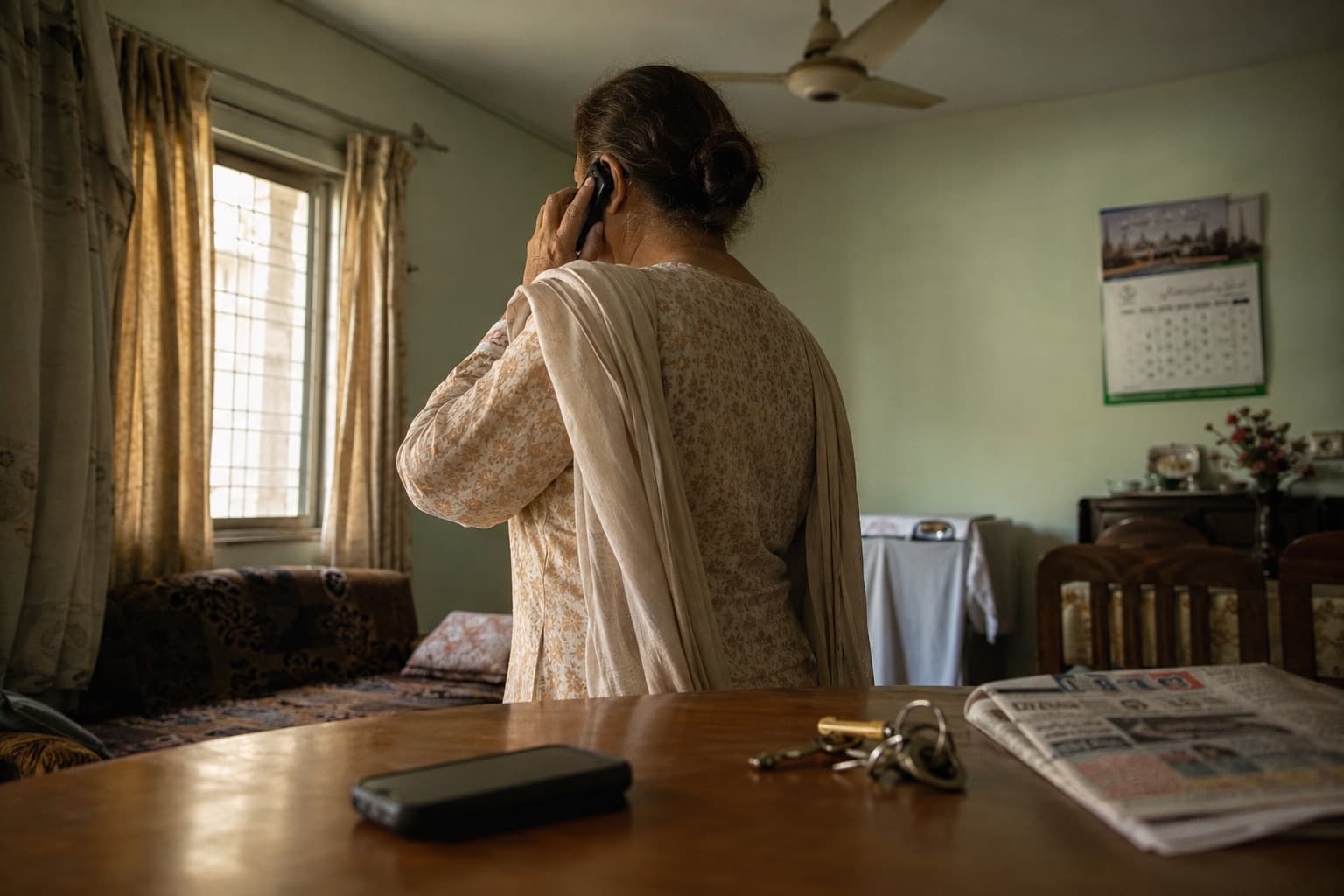
Nasreen is 58. She has used the same bank for twenty years. She has never clicked a strange link in her life.
One afternoon, her phone rang. The screen showed her bank's name.
"آپ کا اکاؤنٹ بلاک ہو گیا ہے۔" means "Your account has been blocked."
The man was calm and polite. He knew her full name. He read out the last four digits of her account number. He said someone had tried to withdraw money, and the bank had stopped it in time.
Then he said he needed to verify her identity. A code would arrive by SMS. Could she please read it out?
She read it out.
₨ 1,85,000 left her account in under two minutes.
Nasreen is not a real person. This story is put together from scam reports that repeat, week after week, across Pakistan. The pattern is real.
Why does this scam work?
The caller is not trying to guess your password. He is trying to make you hurry.
Fear removes careful thinking. When someone says your money is about to disappear, you stop checking and start obeying. That is the whole trick.
Three things make it convincing:
- He already knows something about you. Your name, your city, sometimes part of your account number. These details leak from shop forms, courier slips, and old data breaches. Knowing them costs a scammer almost nothing.
- The caller ID shows your bank's name. Caller ID can be faked with cheap software. A name on your screen is not proof of anything.
- The SMS is genuinely from your bank. This is the cruellest part. The code really did come from the bank, because the scammer typed your details into the bank's own login screen. Your code is the last lock. He needs you to open it for him.
What is the one rule that stops this?
Never say an OTP (the 6-digit code your bank texts you) out loud. To anyone.
Not to a caller. Not to someone offering to help. Not to a person who says they are from the bank, the government, a courier company, or a mobile network.
There is no honest reason for another human being to need that code. If someone asks for it, that alone tells you what they are.
How do I check if the call was real?
Hang up first. Then check.
- Hang up completely. Wait a few seconds so the line clears.
- Find your bank's number on your own bank card, passbook, or bank app, never a number the caller gave you.
- Dial it yourself and ask if anyone from the bank just called you.
A real bank will not be offended. A real bank expects you to be careful. Any caller who tells you not to hang up is telling you exactly what he is.
What if you already gave the code?
Move fast, and do not waste time feeling ashamed. This scam catches careful people every day.
- Call your bank right now on the number from your card. Ask them to block the account and stop any pending transfer.
- Ask for a written complaint reference.
- Report it to your country's cybercrime authority.
- Save the caller's number, the SMS, and your bank's messages. That is your evidence.
Speed decides how much you get back. A call in the first ten minutes is worth more than a complaint the next morning.
Tell your parents this one sentence
Most elderly readers will never remember a list. They will remember one sentence.
"The bank already knows your code. Only a thief needs to ask for it."
Say it to your mother, your father, your uncle. Say it today, before the phone rings.
Frequently asked questions
Can a real bank ever ask me for my OTP?
No. No legitimate bank asks you for your OTP. The State Bank of Pakistan runs public awareness messages telling customers that banks never ask for their OTP, PIN, or card details. Real bank staff can already see your account on their own system. Anyone who asks for that code is trying to take your money.
How did the caller know my name and account details?
Scammers collect details from leaked lists, shop forms, courier slips, and social media. Knowing your name proves nothing. Treat it as normal, not as proof that the caller is real. A stranger who knows one detail about you can still be a stranger.
What should I do the moment I realise I shared the code?
Call your bank immediately on the number printed on your card. Ask them to block the account and stop any pending transfer. Minutes matter. Then report it to your country's cybercrime authority and save the caller's number, the SMS, and your bank messages as evidence.
The caller ID showed my bank's real name. Doesn't that prove it?
No. A caller ID can be faked. Scammers use tools that display any name or number they choose. Never trust a name on your screen as proof. The only safe number is the one you dial yourself, from your card or passbook.
Is my money gone forever?
Not always. If you call your bank fast, a transfer can sometimes be held or reversed. Your chance drops with every hour you wait. Report it, keep every screenshot, and follow up in writing with your bank.
Send this to someone who needs it.
Has this happened to you or someone in your family?
Share your story anonymously. We'll publish only the lesson, never your name. It could save someone else's parents.